
Few areas of road bike technology have shifted as much since the mid-2010s as our understanding of rolling resistance. Two long-held beliefs — narrow is fast, more pressure is better — have been thoroughly disproven by field and lab data. And a long-underestimated component is now moving into the spotlight: the tube inside the tire.
At Tubolito, we deal with exactly this component every day. Time to clear up what actually influences rolling resistance — and what doesn’t.
Rolling resistance is caused mainly by hysteresis — the casing deforms with every rotation and dissipates energy in the process. For years, this principle led to the wrong conclusions.
First, width: Wider tires form a shorter, rounder contact patch at the same pressure. They deform less and, up to a certain point, roll with less resistance rather than more. That’s exactly why 28 mm became the new road standard — with a clear trend toward30 mm and even 32 mm.
Second, pressure: Field measurements reveal a so-called breakpoint pressure. Above this point, rolling resistance doesn’t keep decreasing — it rises again, because an overly hard tire can no longer absorb road surface roughness and instead loses energy tovibration (impedance). On rough asphalt, this can quickly cost over 20 watts.
The rule that follows: When in doubt, go slightly too low rather than too high. Pressure calculators using real system weight get much closer to the optimum than any rule of thumb.
In clincher tires, a tube sits between the casing and the air. And it’s anything but a passive component: it deforms along with the tire, creates friction against the casing, and adds its own losses to the overall rolling resistance.
The ranking is clear:
For riders who’d rather avoid the hassle of tubeless setup or the sealant mess during longer storage periods and stick with a tube setup, switching from butyl to TPU delivers the best watts-per-euro gain in the entire setup.
A calculated optimal pressure only helps if you actually maintain it — and that’s the tricky part: tubes lose air over time, temperature swings shift pressure, and slow punctures often go unnoticed.
The Tubo-Road SYNCD is our TPU road tube with an integrated Bluetooth pressure sensor. It transmits pressure and temperature in real time to an app or Garmin Edge, and alerts you when limits are exceeded or pressure drops. It fits 23–35 mm tires, weighs around 44–46 g, and costs €39.95. The battery lasts up to roughly 10,000 km or two years, after which our replacement program kicks in.
Put plainly: the TPU tube delivers the watts on its own. The sensor makes sure you stay at the breakpoint — a control tool, not a speed miracle.
Move away from “narrow and hard” and toward “as wide and supple as your surface and frame allow” — with the tube as a serious lever in its own right. The result: more speed, more comfort, and fewer punctures — all at once.
In case we ask you to submit product information about your Tubolito for quality review purposes, please send us the following two codes.
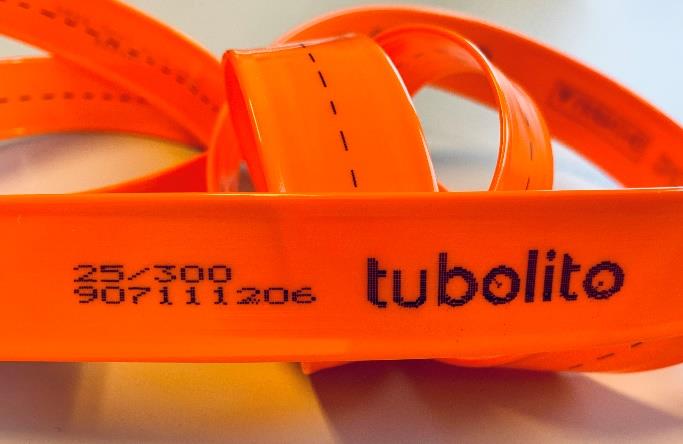
Step 1. Finding the Product Code of your Tubolito:
The product code is a 9 digit code next to the Tubolito logo on your tube.
In the example picture: 907111206
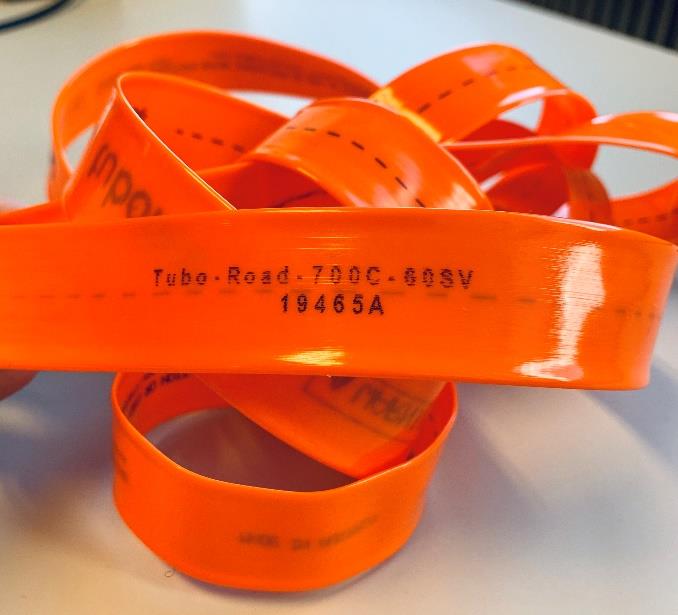
Step 2. Finding the Batch Code of your Tubolito:
The batch code is made up of 4 or 5 digits and a letter and is printed right underneath the name of your Tubolito.
In the example picture: 19465A
Thank you for your help and we hope you continue to enjoy using